

🆕 For those who are new here, The Biotech Tea is meant to be a well-rounded, useful, but never overwhelming resource.
Each week you’ll always see the same sections:
1) Story I’m Watching - a highlight
2) The Bench - a science discovery
3) Bio[Tech] - a tech advancement
4) The Rulebook - a regulatory shift
5) The Human Side - a perspective
And for paid subscribers, each issue ends with the Biotech Term of the Week to improve your understanding and expand your confidence.
Let’s get into this week’s cup of biotech tea. ☕ If you only have time for one this week, I’d start with #3!
Six new peptides recommended by PCAC to be allowed to be manufactured ➡️
A GLP-1/glucagon dual agonist shows promise in reducing alcohol drinking ➡️
A “cochlear implant for blindness” is approved in the EU for vision loss ➡️
In a reversal, Sen Cassidy expresses support of Schwartz for CDC Director ➡️
Tips & tricks for making a graphical abstract with AI - and my thoughts on it! ➡️
Bonus (paid): Summary of FDA Encouraging Innovation series on Monday! ➡️
1. Story I’m Watching
The Tea: Last week the Pharmacy Compounding Advisory Committee (PCAC) voted to allow the manufacturing of several peptides that have been on a ban list for years.
Six of the 7 peptides on the docket were given the green light by PCAC, but now the FDA has to make the final call on whether to lift the restrictions. Emideltide was the only one rejected. It’s important to remember that none of these are FDA approved, meaning we don’t have solid human safety or efficacy data.
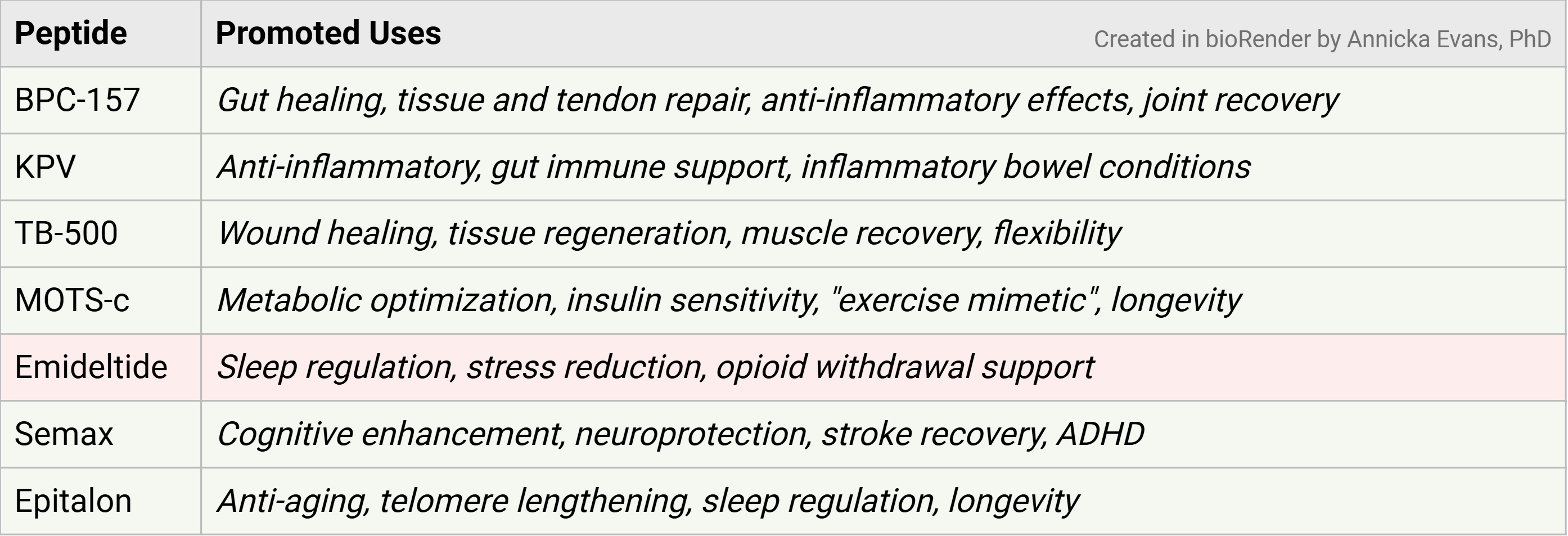
A few more sips: A few weeks back we covered that the panel was stacked with new members just in time for the meeting.

2. From the Bench
The Tea: Altimmune’s GLP-1 & glucagon agonist demonstrated a reduction in drinking in individuals with alcohol use disorder in their Phase 2 RECLAIM trial.
Pemvidutide is a once-weekly dual agonist injection peptide. Excitingly, trial participants on pemvidutide had, over a 24-week period, 4.2 fewer heavy drinking days per week compared to placebo. The number of no-alcohol days also decreased.

The peptide can bind to both glucagon receptor and GLP-1 receptor. Their ‘EuPort’ domain that decorates the peptide, is designed to prolong serum half-life, extending time between doses.
A few more sips: This dual agonist injection has also separately been evaluated for two other indications. Their furthest along indication is fatty liver disease. It was granted FDA Breakthrough Therapy Designation in January of this year based on some of their Phase 2b data (IMPACT). There have also completed early trials (MOMENTUM - Phase 2, 2023) for the more common indication of a GLP-1 agonist — weight loss. However, it appears that it has been deprioritized over liver-centric indications.
Message me if you have a recent science development you’d like to see featured!
3. Bio[Tech]
The Tea: Science Corporation just achieved EU approval of their “cochlear implant for blindness” — PRIMA — for age-related macular degeneration (AMD).
The retinal implant technology was developed to help restore some central vision for people suffering from vision loss associated with AMD. It is being evaluated for other eye diseases but is only approved (and only in the EU) for AMD.


The system is two parts: the retinal implant and the glasses. The glasses have a projector that shines light directly onto the implant, which is placed such that cells in the retina are stimulated. This produces an image in the brain!
4. The Rulebook
The Tea: In a reversal of opinion, Senator Cassidy announced his support for Dr. Erica Schwartz as CDC Director.
In last week’s confirmation hearing, Cassidy seemed to feel very critical of Schwartz in his line of questioning. In her responses, Schwartz refused to make it clear whether she would support HHS Secretary Kennedy or if she’d push back on his policy changes. At the time, Cassidy signaled that he may not vote to confirm her. This week Cassidy reversed this position and announced that he is now in support of her. The confirmation hearing was delayed but is set to happen this week.

A few more sips: For a short bio on Dr. Schwartz, read The Rulebook of this issue.

5. The Human Side
The Tea: In this Nature Career Column, Ananya Thakur, a biochemist at the University of Oulu in Finland, goes over her tips for using AI to create a publication graphical abstract. Along with her tricks she discusses the important responsibility authors have in guiding the design and verifying the output.
As someone who includes manually designed graphical abstract-style figures in my newsletters but also encourages time saving with AI, I have conflicting feelings about this. But as I sit with it today, I realize that because I genuinely love the process of creating figures (I find it to be one of most niche strengths!), the problem I have is that AI removes that creation process for me. But not everyone thinks visually and/or enjoys making figures, and that’s okay. But what do you think?
A few more sips: In case you are interest (because you know I was), she references one of her own papers recently published where she followed her own set of rules. My thoughts? It’s not my favorite but also I’ve seen human-designed graphical abstracts be worse. So maybe it’s a win!

Biotech Term of the Week
Paid Subscriber Bonus Content