

🗣️This week’s issue is in the usual format but with a slightly different flavor! How come? I spent Monday through Thursday of last week attending the 2026 Bioprocessing Summit and wanted to cover some of the highlights in this week’s newsletter!
A fun perk of attending virtually is that you can jump around from ‘room’ to ‘room’ throughout the day, catching anything that seems most interesting. And while there is a lot of diversity in the talks I chose (AAV gene therapy, ADCs, cell therapy, formulation optimization, digital twins, etc.), the general throughline is strategies and technologies being explored to better advance the development of complex therapeutics. Or maybe more fun: “Innovation & AI meets stubborn molecules”.
Let’s get into this week’s cup of biotech tea. ☕ If you only have time for one this week, I’d start with #5!
GeneData, a digital AI ecosystem for bioprocessing co-developed by Novartis ➡️
A new generation of masked antibody-drug-conjugates, developed by Byondis ➡️
BioCurie, in collab with MIT, found a way to capture real-time rAAV titers ➡️
Topic 4 ➡️
Engineering your workforce to be ready to adopt digital tools and AI ➡️
Bonus (paid): Drug-to-Antibody Ratio ➡️
1. Story I’m Watching
The Tea: We all know that AI is making its way into biotech, but most companies still vary on to what degree and how. In the last year I have sat in multiple demonstrations of digital AI ecosystems that are meant to integrate end-to-end (E2E) in bioprocessing. GeneData, co-developed with Novartis, is one such ecosystem that presented at the conference this week. The system actually won an Innovation Practices award at Bio IT World in May of this year!
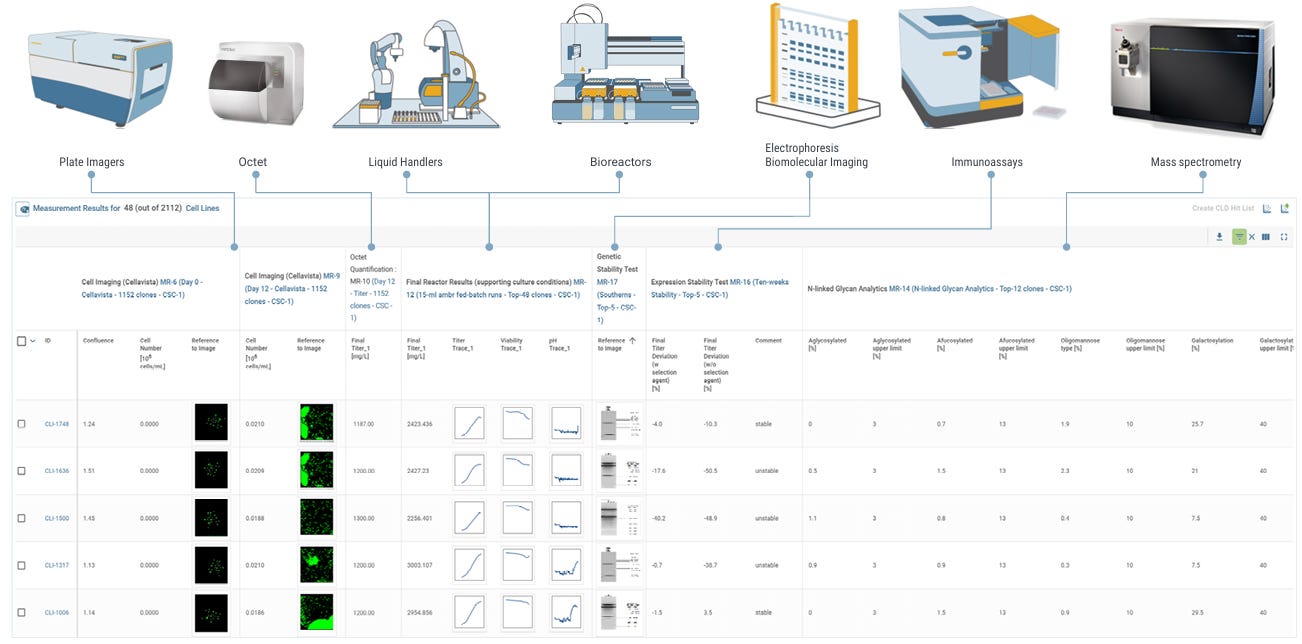
While they have several products, the bioprocessing arm of GeneData is focused on pulling raw data from instruments and acting as an all-in-one system for data processing, modeling, reporting, searching, and interacting with via a built-in agent. Below is an example of the system working for cell line development and clone selection. Real-time bioreactor data can be combined with company historical data to make decisions.
Another such digital tool for bioprocessing that I’ve seen demonstrated is InvertBio.
To me, this feels like such a good way to use AI. Data runs deep in biotech companies, and having digital AI tools to help collect, manage, and interpret, could save significant time.
2. From the Bench
The Tea: Byondis, a small biotech in the Netherlands, has developed a dual-activatable ADC meant to help reduce off-target healthy cell toxicity even more effectively than traditional masking designs.
FYI: We’ve talked about activatable antibodies before (CytomX’s ADC for colorectral cancer).

Byondis noted that with the traditional design — a single protease-cleavable linker and a binding-domain blocking molecule — sometimes, even after cleavage of the linker, the blocking molecule can remain bound strictly off of affinity! They came up with a design aimed to eliminate this risk — ByonGuard. By creating a blocker that doesn’t directly bind to the antibody but hovers close enough to it to sterically block target binding, after cleavage, there is no risk of it remaining in the way.

In the talk I attended, Dr. Danielle van Wiljk, Principal Scientist at Byondis, went over both in vitro and in vivo data that demonstrated a great on-target therapeutic index while also showing reduced toxicity in healthy tissue. They presented proof-of-concept data with a tissue factor (TF) targeting ADC.
A few more sips: Beyond the design, Dr. van Wiljk went over how important it was for them to carefully review the new vulnerabilities of the molecule during the production process. They did many design of experiment (DoE) projects to look at high-molecular weight (HMW) species in their product in response to changes in protein concentration, pH, time, histidine, and salt concentration. The results informed changes in their typical mAb manufacturing process and final formulation that greatly improved stability.
Message me if you have a recent science development you’d like to see featured!
3. Bio[Tech]
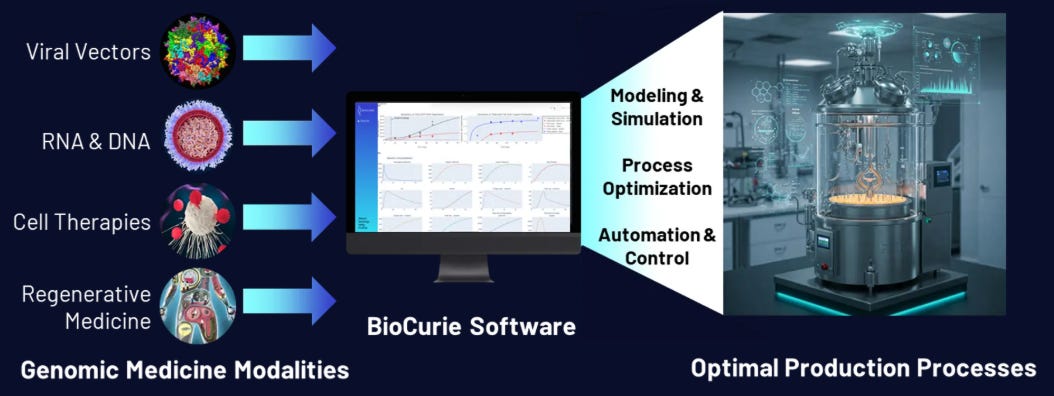
The Tea: Researchers with BioCurie, in partnership with MIT chemical engineering, have demonstrated that size, mass, and density data collected from a single-cell suspended microchannel resonator, paired with a trained machine learning model, produces comparable rAAV titers to gold standard ddPCR or ELISA methods.
Dr. Farncesco Destro, Head of Engineering at BioCurie Inc., presented data on the real-time at-line device for measuring rAAV titer. Gold standard methods for assessing rAAV titer are discreet and laborious — you have to sample your bioreactors at specific time points of interest and run them in either ELISA or ddPCR-based methods to get results. This often takes a few days. By using a microchannel system to measure titer, information about rAAV productivity can be assessed every 10 minutes!
BioCurie is an biotech AI company with the goal of using their predictive modeling software to optimize the production process for a variety of complex biotherapeutics. Just earlier this year they received $9.3M from ARPA-H to optimize gene therapy manufacturing.
4. The Rulebook
The Tea: So, we’ve heard about digital twins for things like manufacturing (we coined them “manufacturing SIMS” in issue No. 3), but what about for more regulatory-centered tasks? Dr. Sri Narayanan, interestingly a dentist by training but now an expert in biopharma AI & modeling, demonstrated the use of digital twin technology for deviation investigations. For example, what if a batch shows an unexpected dip in yield mid-process? The digital twin monitoring system, which is continuously comparing live sensor data against the expected process model and historical batch data, can flag the anomaly much quicker than a manual process. It can alert a scientist who may have the opportunity to intervene and save the batch.
A few more sips: One of the speakers showed this helpful diagram from USP and I thought I’d share it here. It helps differentiate models, shadows, twins, and cognitive twins!

5. The Human Side
The Tea: Dr. Jason Beckwith, Senior VP at Biotalent, gave a fascinating talk on the criticality of continuing to develop an AI-enabled workforce in order to sustain technology adoption. He emphasizes that while advanced tools help optimize bioprocesses, a digitally skilled workforce is what determines if it is successful.
“Technology creates potential. Execution creates value.”
Biotalent, is a consulting company based on measuring ‘Talent Science’ and helping with ‘Workforce Engineering’. Dr. Beckwith has written a white paper on workforce engineering where he goes into quite a bit of detail on this, including a ‘workforce capability function’ that encourages employers to regularly quantify capability density (CD), skills adaptability (SA), success resilience (SR), and workforce alignment (WA).

Biotech Term of the Week
Paid Subscriber Bonus Content
Drug-to-Antibody Ratio (DAR)
Did the Byondis team do head-to-head experiments against standard ADCs?