

Willing to answer 3 quick multi-choice questions so I can get to know you better?
Let’s get into this week’s cup of biotech tea. ☕ If you only have time for one this week, I’d start with #1!
A fridge-free tetanus-diphtheria vaccine just showed safety-efficacy success➡️
A triple combination therapy that may show HIV promise ➡️
Samsung Galaxy Buds have an FDA cleared hearing aid feature ➡️
Proposed updates to the Prescription Drug and User Fees Act ➡️
Token tax? Investment firm executives implore AI policy action ➡️
Bonus (paid): Lyophilization ➡️
1. Story I’m Watching
The Tea: Stablepharma, a UK-based biotech company, has developed the StablevaX technology — a shelf-stable drug formulation that eliminates the need for a fridge!
Cold temp storage is a major limitation of improved global vaccine access. Continuous chilling is difficult and expensive in remote, underdeveloped, or far-from-manufacturing locations. Similarly, having something stay stable for years at higher temps reduces vials that have to be tossed.
StablevaX recently showed great success in a Phase 1 trial testing a temperature-stabilized tetanus-diphtheria (Td) vaccine — SPVX02 — compared to two already approved Td vaccines. While in the trial they just tested safety and efficacy, separately SPVX02 has demonstrated that it retains its potency for at least 2 years stored at 30°C! It’s currently under testing to evaluate if it can extend to 4 years.

A few more sips: The StablevaX technology is proprietary but based on the use of trehalose, a disaccharide sugar. Researchers were inspired by the Resurrection plant and its ability to bounce back after periods of serious drought.

A wide variety of pre-existing therapeutics (vaccines, virus-like particles, inactivated pathogens, peptides, small molecules) could potentially be reformulated in order to reduce fridge dependency.
2. From the Bench
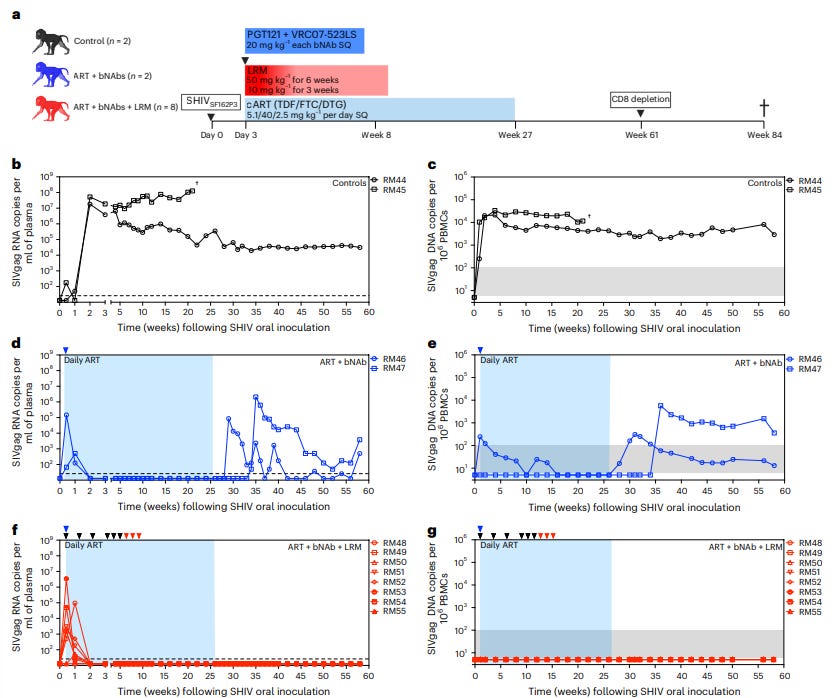
The Tea: CytoDin’s leronlimab, which they’ve been evaluating for HIV treatment for years, has shown promise when used as part of a combination therapy in non-human primate studies. In HIV-infected infant macaques neither leronlimab alone (which is a CCR5-inhibitor) nor antiretroviral therapy (ART) + broadly neutralizing antibodies (bNAbs) showed any positive effect. However, when leronlimab + ART + bNabs were given together, viral RNA copies were reduced to undetectable levels and remained that way for months (even after stopping treatment).
In the image below the black graphs indicate the controls monkeys where you can see high and persistent viral RNA in the blood. The blue graphs are the monkeys that got ART and bNAbs but no leronlimab. In this case you see a reduction in viral RNA in the blood but it rebounds when treatment stopped. Finally, the red lines are with all 3 therapies and you see a reduction in viral RNA that lasts.
A few more sips: CytoDin has a fraught recent history, dating back to early 2020. It’s then-CEO, Nadar Pourhassan, made a series of fraudulent announcements that eventually lead to his ousting by the board 1.5 years later. First, in 2020, he said a BLA had been submitted to the FDA for one of their drug candidates, but that wasn’t true. Next, they tried and failed to pivot leronlimab toward COVID-19 but, despite the disappointing data, Pourhassan still significantly oversold the results. In May of 2021 the FDA publicly rebuked CytoDyn and they were also served multiple subpoenas. In 2024 Pourhassan was convicted on 9 counts, sentences to 30 months in prison, and fined millions of dollars. Through all of this, HIV trials for leronlimab were dirtied and they withdrew their application for approval.
Message me if you have a recent science development you’d like to see featured!
3. Bio[Tech]
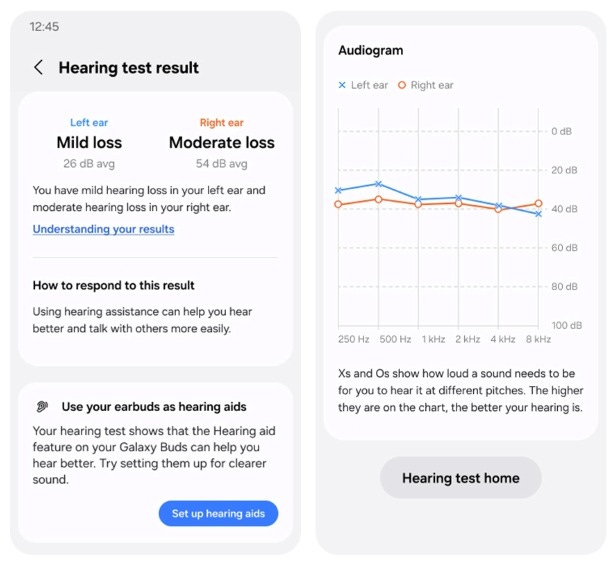
The Tea: Samsung’s Galaxy Buds (3 and 4 Pro) have a hearing aid feature that was just cleared by the FDA! Anyone with a pair of the earbuds can enter the app and perform a hearing test. The 5 minute audiometry test, which identifies which frequencies may be harder to hear and to what degree, results in a person-specific sound amplification profile to improve hearing. If you are more in-the-know on hearing aid tech, it uses a standard NAL-NL2 algorithm in the software to calculate adjustments based on the audiogram results. Talk about making health tech accessible! I’ll definitely be looking into this for someone I know.
4. The Rulebook
The Tea: The FDA released its proposed Prescription Drug User Fee Act (PDUFA) update for 2028-2032. As a reminder, PDUFA is the framework that sets the rules between companies and the FDA when it comes to application fees and review timelines.
A handful of the proposed changes are in line with this administrations interest in incentivizing domestic drug development. One of the proposed changes is a 50% fee reduction if it includes data from a Phase 1 trial anchored in the U.S. (initiated after Oct 1, 2027). Another proposes updating the small-business waiver to only apply for domestic companies. There has even been talk that the fee itself will be different depending on if the sponsor is domestic or foreign (but no specific mention of that in the commitment letter).
A public meeting will be held on September 16th to discuss the proposed updates, and public comment can be submitted until September 2nd!

5. The Human Side
The Tea: In this NYT piece, Greg Jensen and Nir Bar Dea, CIO and CEO of investment firm Bridgewater Associates, wrote about how important AI policy is right now. Bridgewater has believed in AI for years (and can back that up with serious investment history), but, even at their own short-term expense, they are imploring policymakers to make efforts that ensure that even with AI tech we 1) protect human labor and 2) work to make AI equitable. Much of the conversation circles around token tax policy.
“We may have only one shot at taking meaningful action. And though these steps may rattle equity markets and firms like ours that stand to gain from uninterrupted growth in A.I., not taking them and waiting for more societal damage or a catastrophe is more dangerous.”

Biotech Term of the Week
Paid Subscriber Bonus Content
Lyophilization
I’d love to know more about the earbud tech.