

👋🏻 It’s been a minute, so I wanted to remind you who is behind the writing! My name is Annicka, I am an industry biotech scientist (experience in analytical development and CMC regulation), I got my PhD in Bioengineering studying AAV gene therapies, and I have also been an online science communicator since 2020.
That combination is why I try to go a layer deeper than most biotech news — not just what happened, but what it means mechanistically and regulatorily. I love making fit-for-purpose figures that help bring it all together, hence the tagline: Part newsletter, part textbook. All biotech.
Thank you so much for being here.

Let’s get into this week’s cup of biotech tea. ☕ If you only have time for one this week, I’d start with #3!
2026 may be a record-breaking M&A year for the biotech space ➡️
A new recombinant protein therapy for autoimmune kidney disease, IgAN ➡️
Another GLP-1 landscape expansion toward a slow-release implantable device ➡️
Advancing domestic manufacturing through the FDA PreCheck Pilot Program ➡️
A physicians take on if you really need 8 hours of sleep ➡️
Bonus (paid): Market Exclusivity (6th of FDA Encouraging Innovation series) ➡️
1. Story I’m Watching
The Tea: The biotech space is buzzing with merges & acquisitions (M&As) this year, with over 45 deals at a value of around $135B*! In all of 2025, which was actually one of the better years recently, total deal value was $133B. If the second half of this year is as busy, 2026 may be a record year for deals. And what’s more, there is quite a bit of diversity amongst both what is being purchased, and by whom. Let’s break down the M&A 2026 surge into 3 takeaways:

The buyer pool has broadened to include more mid-size companies. This is likely on the tail of biotech valuation starting to rebound (but still being much less than the 2020-2021 peak), giving companies that have been outpriced the last few years, an window of opportunity to acquire with their cash reserves.
There is diversity in purchased assets. So far this year, oncology is around 33% of total deal value, with immunology-based therapeutics coming in around 29% and neurology-focused drugs around 14%. The remainder cover women’s health, rare disease, and infectious disease.
Finally, it is becoming more common to see deals structured to include Contingent Value Rights (CVRs) into deal structures. Essentially, when buyer and seller don’t necessarily agree on the risk profile of a certain early-stage asset, you can put in the deal that money will be tied to certain program milestones. For example, Apellis shareholders will receive $41 per share upfront (from Biogen), plus up to an additional $4 per share based on annual sale goals of their macular degeneration therapy, Syfovre.
A few more sips: Endpoints News covered the first half of 2026 (45 deals at $125B) but since reporting, Vertex acquired Crinetics Pharma for $10B! So, we’re already over the 2025 deal total!
2. From the Bench
The Tea: There is a new therapy on the market for IgA nephropathy (IgAN), an kidney autoimmune disease caused by the buildup of abnormal antibodies in the kidneys. Vera Therapeutics was awarded approval of Trutakna, a recombinant protein therapy that works by reducing the production of these abnormal IgA antibodies, slowing disease progression.
IgAN therapies on the market today, have left room for improvement, with many patients still seeing loss of kidney function over time. Most similar to Trutakna is Otsuka, which was approved by the FDA just last year. While Otsuka targets one important protein in the pathway that leads to abnormal antibody buildup (APRIL), Trutakna targets two (APRIL & BAFF).
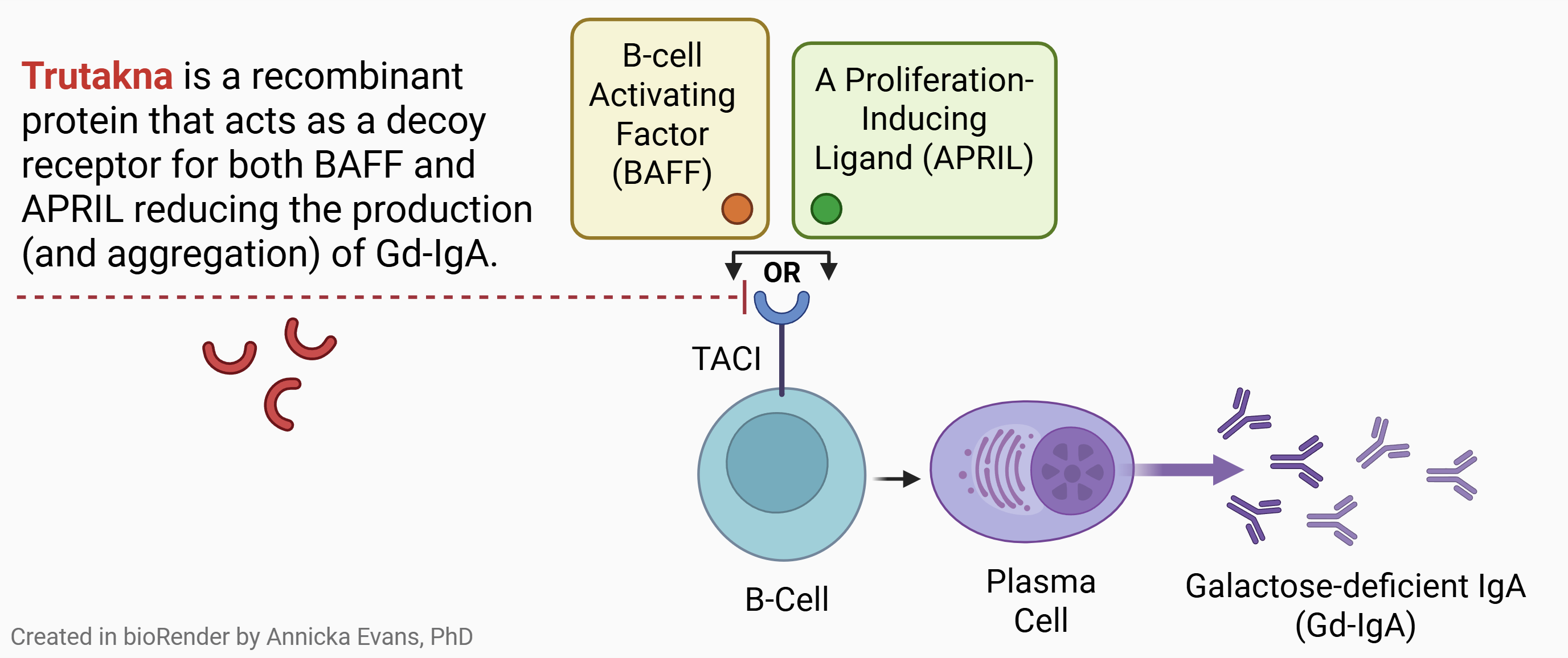
The data from the Phase 3 study showed that there was a significant reduction in the protein-to-creatinine ratio which is a strong indicator of kidney function. The group taking Trutakna showed a 45.7% reduction from baseline while the placebo group showed only a 6.8% reduction.
Message me if you have a recent science development you’d like to see featured!
3. Bio[Tech]
The Tea: The GLP-1 space is rapidly evolving as companies compete to find safer, more effective, or more convenient options for patients. Toward the goal of improving convenience… Novo Nordisk, which produces the oral semaglutide Wegovy, just announced a partnership with medtech company, Vivani Medical, to evaluate, and potentially help advance, Vivani’s slow-release implantable GLP-1 system.
Vivani has a proprietary NanoPortal platform technology designed to remain stable in the body and release medication over an extended period of time. The platform can be custom designed per molecule and has demonstrated efficacy using larger molecules and peptides. The therapy is loaded within the device reservoir and slowly released through custom-size nanotubes on the ends of the device.
Vivani has been working on a semaglutide device, NPM-139, and they plan to initiate a Phase 1 trial comparing it to Wegovy injections this year.
A few more sips: On their website, Vivani discusses ‘The Goldilocks Effect’ of nanotube pore size. The ratio of molecule size to pore size is critical for determining release kinetics.

4. The Rulebook
The Tea: The FDA announced the first seven companies participating in their PreCheck Pilot Program, aimed to aid in the readiness of new domestic manufacturing facilities for therapies of unmet needs.
Participants get to engage with the FDA both for building out the manufacturing facility & for the drug application. Pre-submission FDA meetings will provide technical guidance for getting the facility operational and try to identify issues before they potentially delay a submission.
The following companies are the pilot participants:
Amneal Pharma, Cellares Corp., Eli Lilly, FUJIFILM Biotech, Kriya Therapeutics, Kyowa Kirin, and Regeneron.
5. The Human Side
The Tea: In this New York Times opinion piece, Dr. McCormick, a primary care physician, takes us through why the long-held recommendation of 8 hours of sleep is too simplified.
“Both sleep and insomnolency, when immoderate, are bad.” - Hippocrates
While sleep is, of course, biologically very critical, we know that individual needs will vary greatly. Like with all guidelines, they are meant to provide useful guidance that covers the majority, but never fully cover all the nuance. I enjoyed that this piece summarized the general holes to look out for in epidemiology studies, historical sleep patterns we can learn from, as well as what we can observed from other cultures that live differently.

Biotech Term of the Week
Paid Subscriber Bonus Content
Market Exclusivity
