

📌A quick note: Starting October 8th, The Biotech Tea will alternate weekly between issues that are free for everyone and issues exclusively for paid subscribers. The subscription price will also move to $60/year. If you've been on the fence, subscribing before October 7th at 11:59pm MST permanently locks you in at $30/year. If you missed the announcement email (sent on 9/14), I cover the details and my reasoning! Worth a read prior to the deadline. And lastly, if this is helpful, there is still plenty of time to ask work to cover your subscription through professional development budgets using this short email template I drafted.
Let’s get into this week’s cup of biotech tea. ☕ If you only have time for one this week, I’d start with #1!
A look at heparan sulfate as a biomarker for a few rare disease gene therapies ➡️
Cannabinoid receptor agonist shows weight loss in an obese mouse model ➡️
An at-home COVID-19 nucleic acid test gets FDA 510(k) approval ➡️
A look at an FDA report covering complete response rate trends since 2008 ➡️
Why isn’t there a ‘pregnant or lactating’ filter on ClinicalTrials.gov? ➡️
1. Story I’m Watching
The Tea: Just last week, Ultragenyx received FDA approval for Fayuvi (UX111), an AAV gene therapy for Sanfilippo syndrome type A — a rare inherited metabolic disease in the group of mucopolysaccharidoses (MPS). It is one of a series of MPS-targeting gene therapies that have submitted to the FDA in the last few months using the biomarker heparan sulfate as the clinical trial readout. This stood out to me so I wanted to dive in and give a summary!
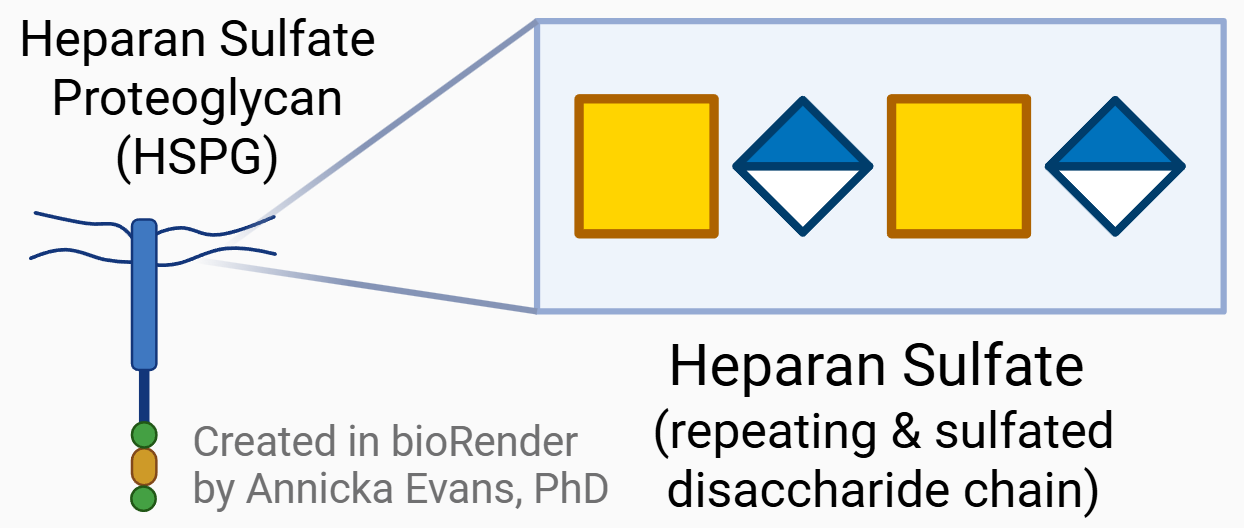
Heparan sulfates (HS) are long, sulfated carbohydrate chains found on cell surfaces (usually as part of proteoglycans) that, in a healthy state, are constantly turned over. In diseases that result in certain enzyme deficiencies, such as in MPSs, HS can build up.
Fayuvi of Ultragenyx, Avlayah of Denali, and RGX-121 of RegenxBio, all strategically chose to use HS build up as an endpoint compared to the much more difficult to capture neurodevelopmental clinical measures. As you can see from the table I made below, there have been varying outcomes for MPS trials using HS as the endpoint. Will definitely be watching for HS use in more trials!
2. From the Bench
The Tea: Interesting data in mice just demonstrated that a cannabinoid receptor (CB) agonist may be promising for weight loss. The recently published data showed that Artelo Biosciences’ ART27.13, an oral agonist against both CB1 & CB2, resulted in comparable weight loss to semaglutide on it’s own (20% over 4 weeks), and further, when combined with semaglutide, weight loss doubled (40% over 4 weeks). Importantly, the therapy only resulted in weight-loss in obese mice.

A few more sips: ART27.13 was originally developed and trialed for cancer anorexia-cachexia syndrome. In the Phase 2 CAReS study, patients on the therapy saw a weight gain of around 6% compared to a weight loss of around 5% in placebo.
If you’re a bit confused about how it helps with weight gain in one indication and weight loss in another, you’re not alone. Historically, CB agonism has been thought to increase appetite and therefore increase weight. Two synthetically derived THC-like products, Marinol and Syndros, have been approved by the FDA for chemotherapy associated nausea and treating weight loss from anorexia or in AIDs patients. CB antagonism intuitively would be the opposite. Because ART27.13 is showing weight-loss in obese mice, but not in lean mice, it’s being called a “metabolic regulator”. Results differ depending on the phenotype being treated (lean vs. obese).
Message me if you have a recent science development you’d like to see featured!
3. Bio[Tech]
The Tea: The FDA just granted Aptitude 510(k) clearance for its COVID-19 at-home nucleic acid test that can be run on their Metrix reader device. The product had been operating on emergency use approval (EUA) prior to this. Their COVID-19/Flu combined test is currently under review for 510(k) clearance, and they are developing a test that includes RSV.
Personally, I’m intrigued by at-home nucleic acid-based tests. As they are more sensitive than lateral flow-based tests detecting viral antigen, it seems like a useful option for catching infections early. The Metrix reader is currently showing as $50 on their website, but the bulk of the cost comes from individual tests which cost anywhere from $25-45.
4. The Rulebook
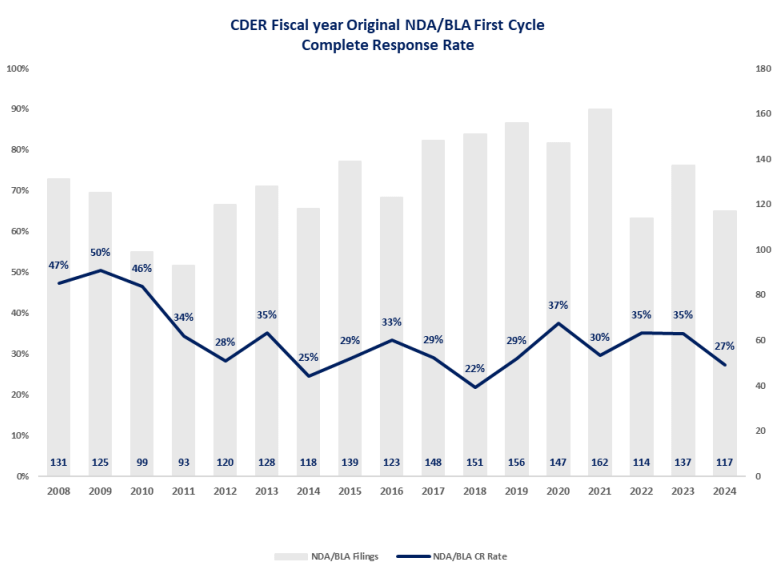
The Tea: The FDA, in response to criticism that there has been an increasing number of early drug application rejections, released a report on complete response rates this past week. It covered NDA and BLA applications through CDER from 2008 to 2024. From the data they present (graph below), you see an overall downward trend.
5. The Human Side
The Tea: If you’ve ever been on the side of searching for a clinical trial for yourself or a loved one, you know about ClinicalTrials.gov. In this opinion piece written by 3 faculty at Brown University, they make the keen observation that there is no way to filter available trials for individuals who are pregnant or lactating. The article walks through a high-level current history of trial participation for this group of people, the progress we’ve seen, and the remaining gaps.

Biotech Term of the Week
Paid Subscriber Bonus Content