We’re back to regular Biotech Tea issues!
📌A quick note: On October 8th, The Biotech Tea shifts to an every-other-week paid model and the subscription price moves to $60/year. If you've been on the fence, subscribing before October 7th at 11:59pm MST permanently locks you in at $30/year. If you missed Monday's email, I cover the details and my reasoning! Worth a read prior to the deadline. And lastly, if this is helpful, there is still plenty of time to ask work to cover your subscription through professional development budgets using this short email template I drafted.
Let’s get into this week’s cup of biotech tea. ☕ If you only have time for one this week, I’d start with #3!
Definium achieves another late-stage LSD therapy success for general anxiety ➡️
Mushroom compound shows promise in reducing chemotherapy neuropathy ➡️
Echocardiograms in space give insight into Mars mission preparation ➡️
FDA TrialBlazer pilot applications open for biopharma sponsors ➡️
Elisabeth Marnik, a prominent scicommer, grew up in an anti-vaccine home ➡️
1. Story I’m Watching
The Tea: A late-stage, 12-week trial, of DT120 — an LSD therapy developed by Definium Therapeutics — saw a significant reduction in anxiety compared to placebo. In trial Panorama, the Hamilton Anxiety Rating was the primary indicator measuring anxiety and those on DT120 saw a 9.8 point drop on the scale compared to 4.7 point drop experienced by placebo. This is a confirmatory late-stage trial that shows comparable results to the first late-stage trial, Voyage.
A few more sips: This is Definium’s 4th trial looking at LSD DT120 for either anxiety (generalized anxiety disorder, GAD) or depression (major depressive disorder, MDD). In the space of psychiatrics, it’s common to submit for regulatory approval with two separate late-stage trials that show success.
2. From the Bench
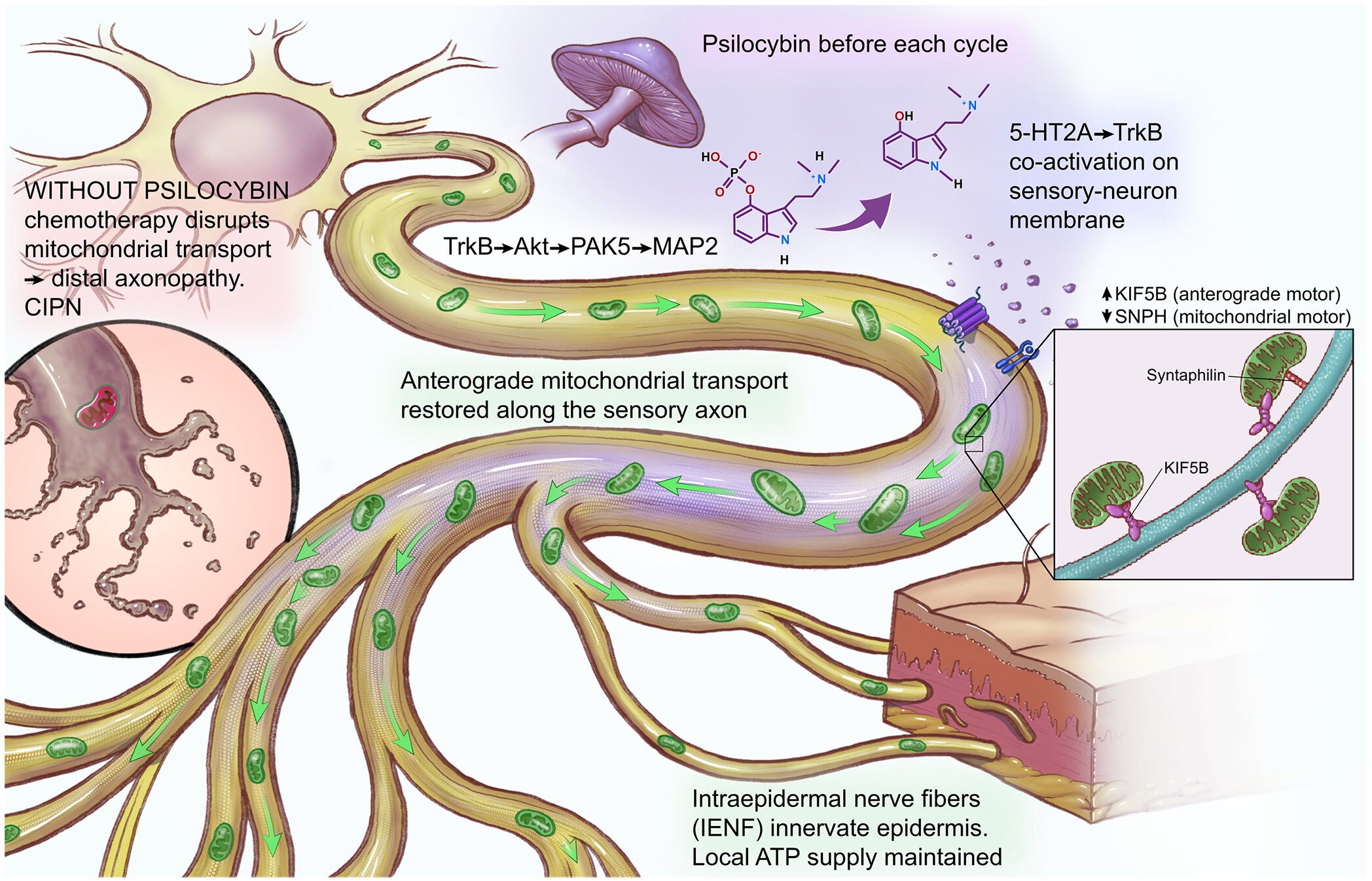
The Tea: On the psychedelic train… early mouse data from MD Anderson shows the potential of mushroom compound, psilocybin, in treating chemotherapy induced peripheral neuropathy (CIPN). Patients can experience limb sensitivity, numbness, or tingling for weeks to years after certain platinum-based chemotherapies as a result of injury to sensory nerves and other physiologic or cellular changes (including mitochondria dysregulation).
Psilocybin, found in mushrooms, was hypothesized to have protective effects if given prior to chemotherapy. Researchers found that in mouse models, few pre-therapy doses were needed in order to successfully reduce nerve hypersensitivity.
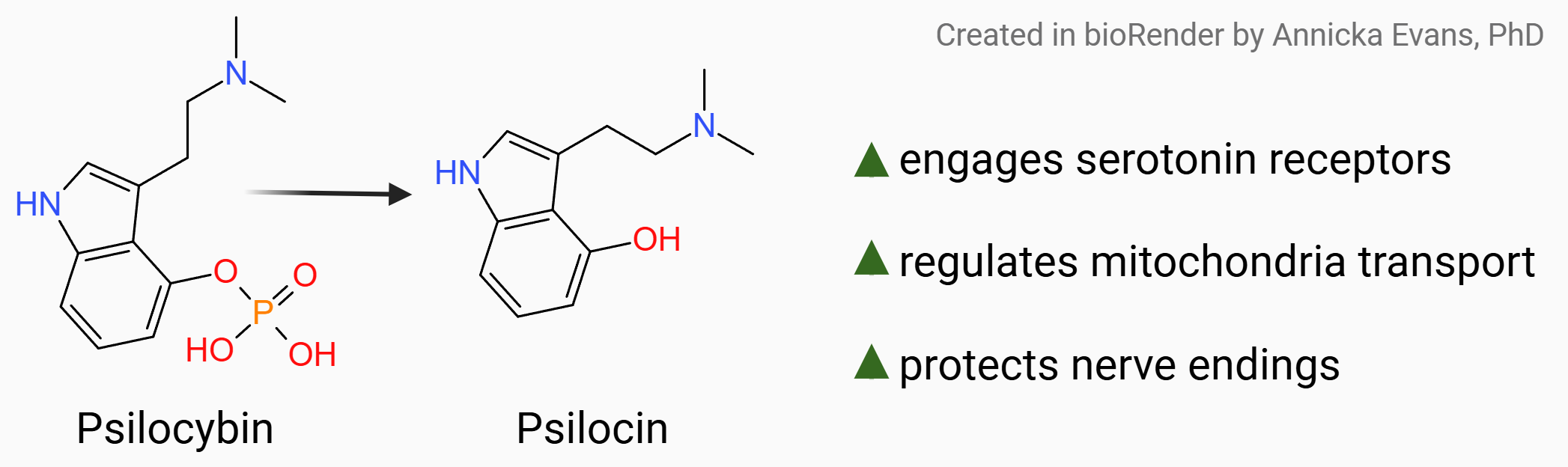
A few more sips: Psilocybin is a prodrug that, once converted to Psilocin, acts as a serotonin 5-HT2A receptor agonist. To better understand the mechanism, here is the abstract and description from the publication.
Message me if you have a recent science development you’d like to see featured!
3. Bio[Tech]
The Tea: With the help of Earth-side sonographers, 13 astronauts were able to do regular echocardiograms on themselves in space to contribute to important data on how the heart responds to prolonged exposure (6 months) to microgravity. Until the recently published data in Circulation, cardiovascular health and space had more limited information; but in preparation for the (currently slotted) 2035 Mars mission, NASA wants to better understand what precautions or measures may need to be taken for the health and safety of the crew. Ultimately, they discovered that while there were changes early in the space time, by the end of the 6 months, most values had stabilized, and changes were not outside the range of normal for humans on earth.
A few more sips:
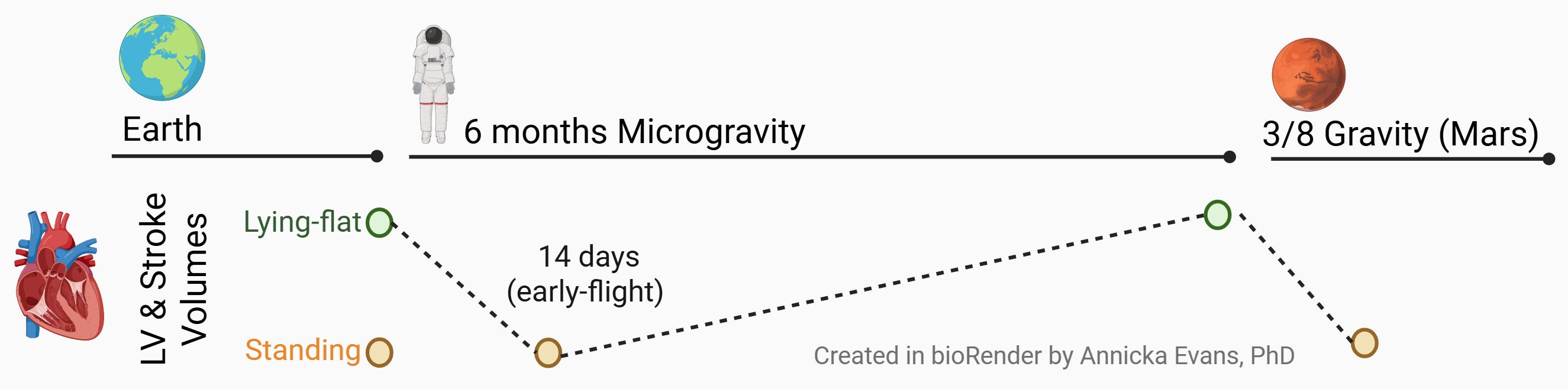
Important to understanding the results, the measures of our hemodynamics shift on earth even between supine positioning (lying-flat) and upright (standing).
Early flight values (first 14 days) for measures such as left ventricular end-diastolic volume and stroke volume decreased compared to lie-flat values on earth; however, they were actually pretty similar to standing values on earth. Even with that change, by the end of the six months, the values had stabilized and were again closer to the lie-flat earth values. The final part of the study was evaluating how the crew member’s hearts reacted to Mars gravity (which is roughly 3/8 of Earth’s) after the 6 months, which is roughly the mission time it would take to reach the red planet. There was noticeable change, but again only around the values of standing position on earth.
4. The Rulebook
The Tea: This summer the FDA announced the pilot program TrialBlazer — another initiative to try and move the FDA review process along quicker. Just this week the application — to be one of the 10 early guinea-pigs of the program — opened.
TrialBlazer aims to pair industry sponsors with qualified research institutions (QRIs) in order to both aid in the more efficient development of a quality IND application and partially review them. The FDA will then be able to review portions of the application on a rolling basis, knowing that they have already been looked over by a QRI.

A few more sips: The new FDA CBER Director, Karim Mikhail, has stated that the QRI umbrella is purposely large. The idea is for the sponsor to select the most appropriate consultant to fit the job. When it comes to conflict of interest (COI), Mikhail states that the FDA is still doing all the final review, so that should be of low concern. I think it will be interesting to see how much review is QRI vs FDA. In order to effectively save time, you’d imagine that the QRI would do some heavy lifting, in which case COI does matter.
5. The Human Side
The Tea: A good friend and colleague had a bio written about her in STAT last month and I wanted to have a chance to cover it! Elisabeth Marnik, PhD , director of The Evidence Collective and Chief Scientific Officer of Those Nerdy Girls, grew up in a strict Evangelical Christian home that was anti-vaccine. She is now an avid science communicator who advocates for empathy, above all else. In this article you are able to see how her past dramatically shaped how she approaches vaccine advocacy and public health work. If you’re on the fence about how to approach conversations with those who are hesitant or against modern day public health initiatives, I think reading her perspective is of value.

A few more sips: Liz is a dear friend and just walked the West Highland Way with me! I first met her in 2021 doing science communication on social media and I now work with her at The Evidence Collective.