

🙏🏼 A few of you have already claimed the Early Supporter discount (lifetime access at $20/year), and I’m excited to welcome more readers to Biotech Term of the Week. The offer closes tonight and won’t be offered again. If you've been considering supporting The Biotech Tea ☕, now is a good time.
Let’s get into this week’s cup of biotech tea. ☕ If you only have time for one this week, I’d start with #1!
A peak into CEO-to-Worker salary ratios and insights➡️
We hear about the measles vaccine but what about a new antibody treatment?➡️
An tissue engineered heart muscle patch used for heart failure patients➡️
Do blood pressure wearables get regulated as medial devices?➡️
A physician-scientists take on the ‘reference paradox’ for job applications➡️
Bonus (paid): Humanitarian Device Exemption (2nd of FDA Encouraging Innovation series) ➡️
1. Story I’m Watching
The Tea: Endpoint News has begun releasing parts of their biopharma employee salary report for 2025 and they reported the median biopharma salary (which they weighted for head-count of company) was $115.6k. That’s higher than the typical salary for an employee of an S&P500 company.
What struck me most was looking at the CEO-to-Worker salary ratios. ThermoFisher has the highest (1120) with the CEO making $79.9M. Novo Nordisk has the lowest (19.9) with the CEO making $3.5M.
I spent some time looking at the numbers, graphing them in ways that helped bring some stories to light, and coming up with groups I felt were insightful.
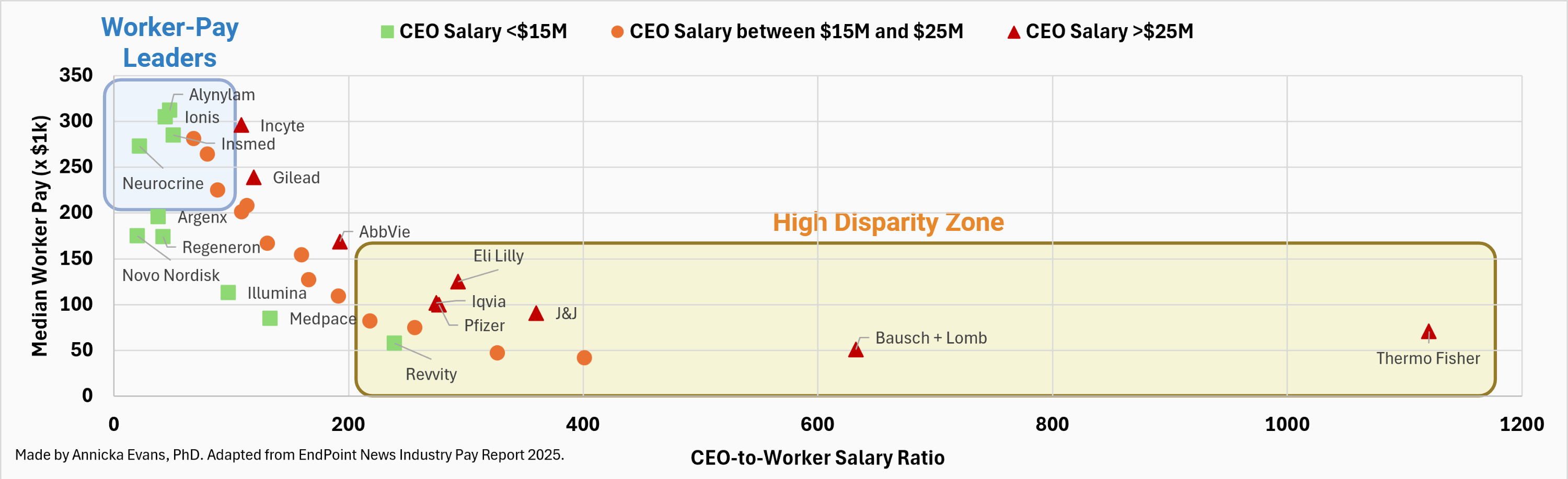
Worker-Pay Leaders I defined as companies with a CEO-to-Worker ratio <100 and a median worker pay >$200k. You can see no CEOs make more than $25M in this category. Incyte just barely misses the grouping because while the median worker salary was quite high, the CEO made $32.1M.
High Disparity Zone I defined as a CEO-to-Worker ratio >200. While the majority of companies in this group have higher bucketed CEO salaries, Revvity is unique for this category in that the CEO makes less than $15M. But because the typical median worker salary is so low, it makes it into this category.
Take a look at the graph and let me know what insights you find!
A few more sips: Portland, OR was the first place to pass a business tax surcharge based on CEO-to-Worker salary ratios. In San Francisco the ‘Overpaid CEO tax’ narrowly failed passing just last week. And in 2025, the Tax Excessive CEO Pay Act was reintroduced, aiming for the same kind of penalty system for high disparities between CEOs and workers.
2. From the Bench
The Tea: With the unfortunate resurgence of Measles, better understanding how vaccine-derived antibodies neutralize the virus (where exactly they bind) is important information for developing antibody therapies.
Real quick: It may surprise you when you realize that we don’t already have a Measles-specific treatment, but it’s because preventing infection of the highly contagious virus, through vaccination, is so effective. And with the disease being eradicated in the U.S. in 2000, efforts for a treatment weren’t prioritized and new technology hasn’t been applied. Back to the findings…
Researchers at La Jolla Institute for Immunology recently published their work characterizing antibodies from people who had been immunized and data showing what specific regions the antibodies recognize on two important viral surface proteins — hemagglutinin (H) and fusion (F). This kind of virus-to-antibody mapping work isn’t novel, but it fills important gaps in our understanding of Measles virus immunity. It opens the door to developing an antibody therapy that could be used for pre- or post-exposure therapy in high-risk groups if Measles cases continue to rise.

A few more sips: There is also work being done to develop antivirals against Measles! A lab at Georgia State University, in particular, recently published data on a broad spectrum drug targeting machinery of orthoparamyxoviruses (e.g. measles & parainfluenza). The work was funded by the National Institute of Allergy and Infectious Diseases (NIAID) and the National Institutes of Health (NIH). It has yet to be tested in humans but showed promise in animal studies.
A few more sips:
Message me if you have a recent science development you’d like to see featured!
3. Bio[Tech]
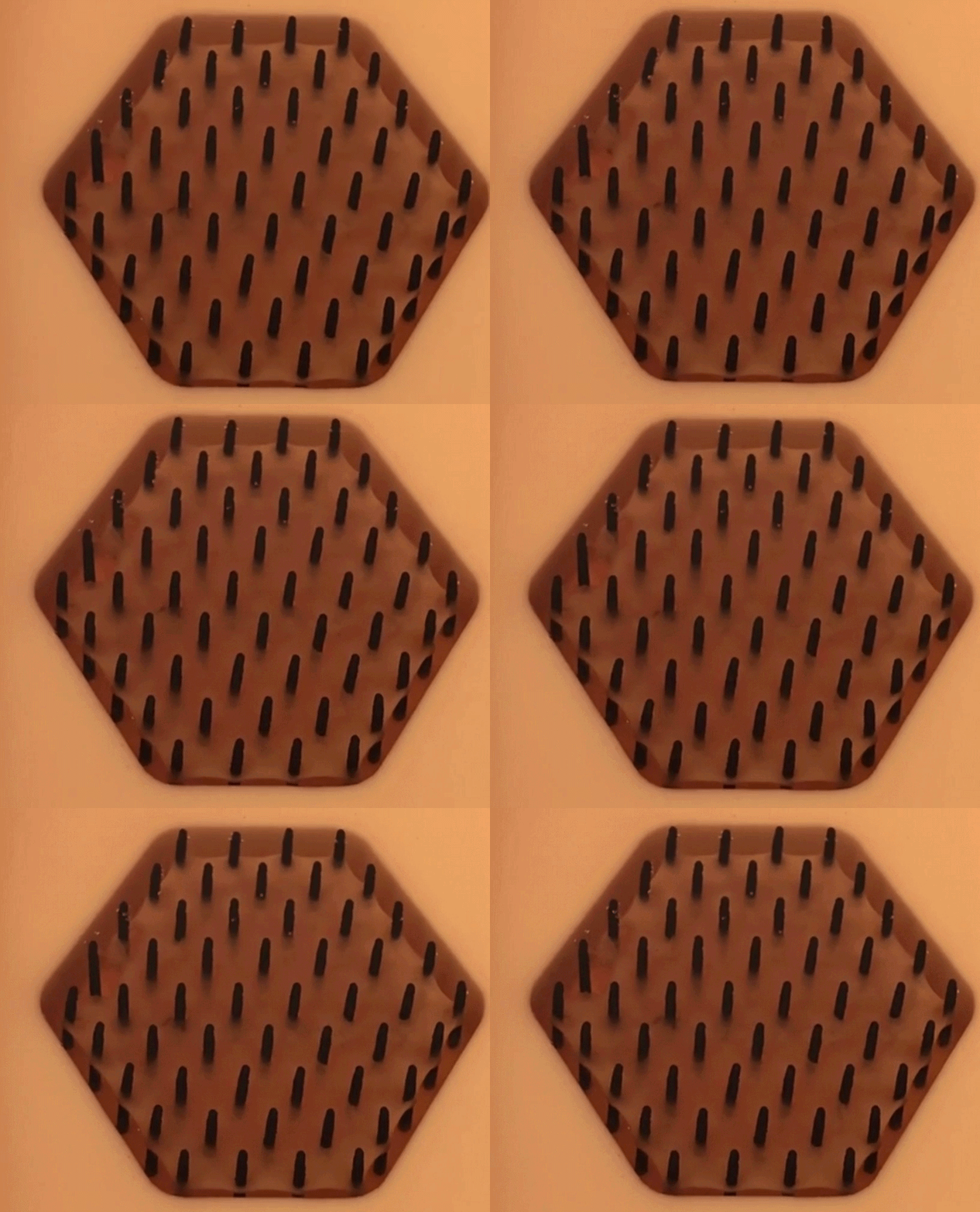
The Tea: Researchers in Germany have engineered a patch of heart muscle derived from stem-cells that shows potential in boosting weakened heart tissue in heart failure patients.
At late stages of heart failure, the heart loses its ability to effectively pump blood, and you see a significantly lowered left ventricular ejection fraction (LVEF). It is in those scenarios that a patient may be indicated for a left ventricular assist device (LVAD), which is literally a pump that is inserted into the ventricle of the heart that assists the heart in circulating blood throughout the body. (Fun fact: Yours truly worked as an LVAD tech part time during undergrad and it was a really fun job that exposed me to clinical care and retrospective research).
A total of 16 patients (who had heart failure and a LVEF less than 35%) received the engineered heart muscle patch and were followed up for 3 months. The heart wall showed an increase in thickness and the LVEF demonstrated a small improvement.
4. The Rulebook
The Tea: Earlier this year the updated FDA guidance that relaxed regulation on wearables (low-risk devices) “intended for only general wellness”, which has opened the floodgates for companies to offer blood pressure readings.
“FDA may consider certain products that use non-invasive sensing (e.g. optical sensing) to estimate, infer, or output physiologic parameters (e.g. blood pressure, oxygen saturation, blood glucose, heart rate variability) to be general wellness products when such outputs are intended solely for wellness uses…” - Guidance Doc
In just the last few months the list of wearables with this feature has skyrocketed — Whoop, Oura, Samsung, Pin Pulse, just to name a few (Apple sought FDA clearance for it’s feature). While some consumers may appreciate this added feature, many are skeptical that allowing devices to give this kind of information without regulation could result in patients not seeking accurate diagnostic measurements and proper care.
A few more sips: How does a wearable blood pressure measurement even work? Most of the devices repurpose the sensor used to measure heart rate but apply specific algorithms that try to use the readings to infer pulse volume and pressures. At the end of last year the American Heart Association published a statement warning against the lack of accuracy and precision in the cuff-less blood pressure tech.
5. The Human Side
The Tea: In this opinion piece by physician-scientist Bibek Aryal, he argues against the usefulness (and hinderance) of letters of recommendations for first round job applications.
His reasoning is two-fold: in a highly digital era, we no longer rely on letters from former employers to confirm skills, publications, or degrees. Second, it is a privilege (and something quite out of our control) to have mentors that will take the time (often again and again) to write recommendations.
Aryal isn’t anti-recommendation entirely, but suggests that they be only used for finalists.

Biotech Term of the Week
Paid Subscriber Bonus Content
Humanitarian Device Exemption (HDE) (FDA Encouraging Innovation series)
