

Let’s get into this week’s cup of biotech tea. ☕ If you only have time for one this week, I’d start with #4!
Biotech companies weight in on Mifepristone court ruling ➡️
Harnessing the “jumping gene” system to turn cells into GLP-1 factories ➡️
A migraine electrical nerve stimulation device approved for Hinge Health ➡️
FDA’s new pilot to try and speed up clinical trial timelines ➡️
A career built on developing genetics curriculums that reduce racism, ended ➡️
Bonus (paid): Breakthrough Therapy Designation (2nd of FDA expedited programs) ➡️
1. Story I’m Watching
The Tea: You have likely seen headlines discussing the new wave of cultural and political conflict around Mifepristone. But while the conversation is often led by politicians, judges, and doctors on the matter, let’s dive into how pharma is responding.
Shortly after a federal appeals court in New Orleans challenged telehealth prescriptions and mail delivery of Mifepristone, two of the drug’s manufacturers (Danco and GenBioPro) filed emergency appeals.
The ask? Keep access to the drug unchanged unless new safety data supports a reversal.
The Supreme Court responded with a temporary “administrative stay”, pausing any court ruling just through May 11th.
While both companies are aligned, their appeals highlight different risks. Danco emphasizes the dangerous precedent this could set for courts playing a role in the drug approval system. GenBioPro focuses more on the possible downstream effect, noting how a sudden change driven by a single state could disrupt patient access nationwide.

A few more sips: While all drugs are monitored after approval, some, like Mifepristone, have an added safety layer called a REMS (Risk Evaluation and Mitigation Strategy). This means the FDA actively manages and adjusts prescription and distribution based on ongoing safety data. Overtime, REMS requirements have been adjusted as data becomes available. Most relevant to current events is 2023, when REMS data assessments, paired with shifts in patient care (thanks to the pandemic), eliminated the requirement to have in-person dispensing.
This current legal battle seeks to overturn this recent update without new supporting REMS data. And while courts have influenced access before (2021 waive of in-person requirements), the FDA still made the final regulatory decision after reviewing the data.
2. From the Bench
The Tea: A team of UC Berkeley scientists is aiming their “selfless jumping gene” technology at the weight-loss market. They are one of many companies trying to make GLP-1 drug delivery last longer in the body using gene therapy, reducing patient dosing.
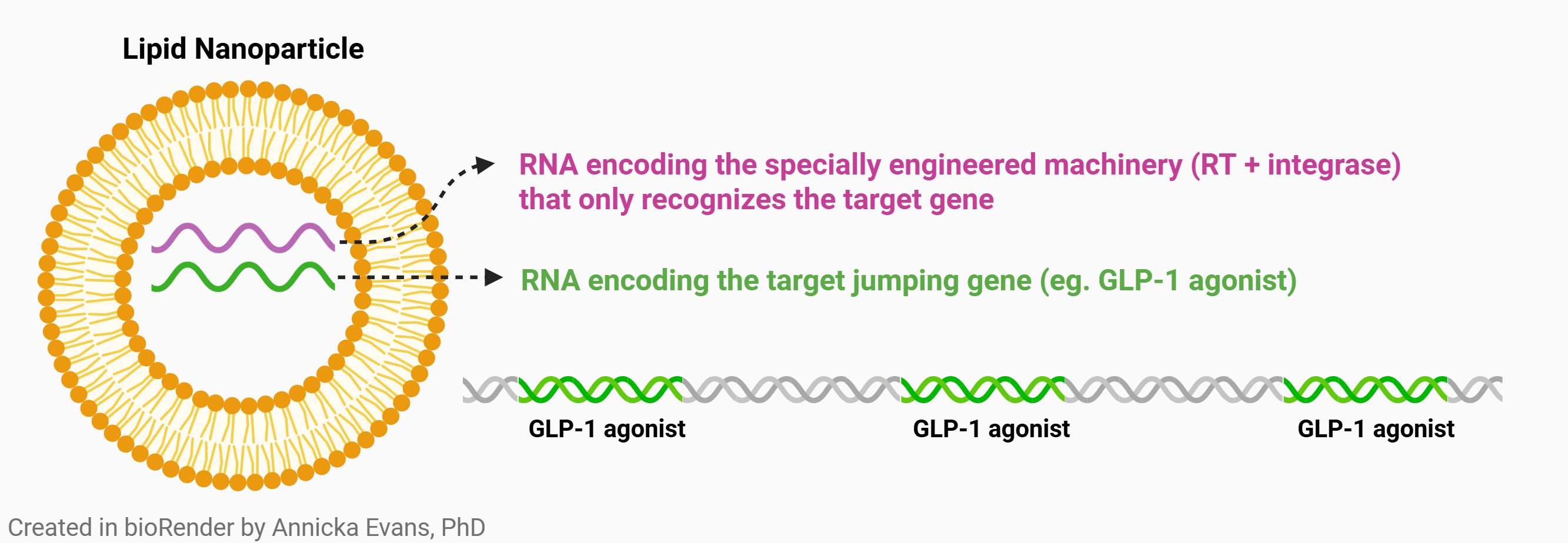
Addition therapeutics has an RNA-lipid nanoparticle (LNP) platform coined PRINT (Precise, Rna-mediated, INsertion of Transgenes) that harnesses retrotransposon biology to turn cells into little factories that make whatever target gene you want.
By making your liver cells produce their own GLP-1 agonist long-term, you could eliminate the need for continuous injection (or oral dosing).
A few more sips: Transposable Elements (TEs or jumping genes) are segments of DNA in the genome that encode machinery like reverse transcriptases & integrases that allow them to be copy-pasted, increasing the number of DNA copies, which can increase protein expression.
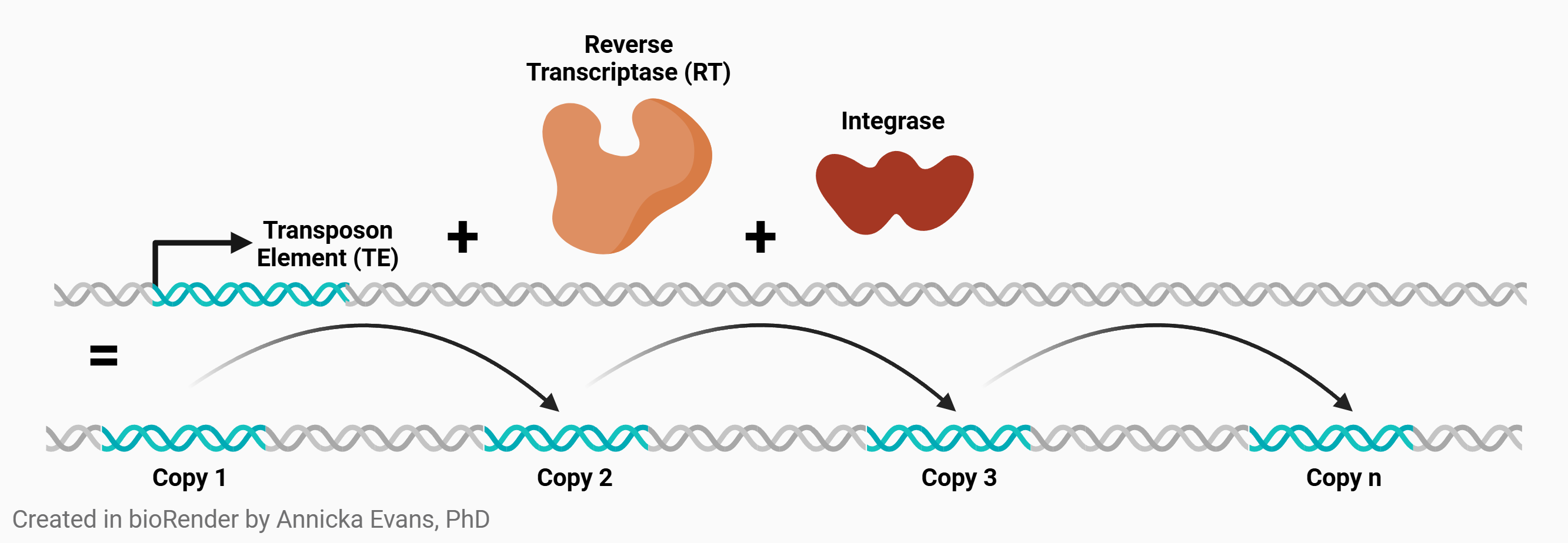
PRINT is able to harness this copy-paste function but introduce a desired jumping gene into the cell (for example a GLP-1 agonist) AND direct it to a certain place (as to not disrupt important coding genes). From early data on the technology, it appears they are targeting highly repetitive ribosomal DNA (rDNA) coding regions that already exist in multiple places throughout the genome.
Message me if you have a recent science development you’d like to see featured!
3. Bio[Tech]
The Tea: While drugs still play a crucial role in patient care, treatment is increasingly becoming more multi-faceted. An example? Hinge Health just expanded its digital health platform for migraines by introducing an electrical nerve stimulation device (Enso) that pairs with their user-friendly software. In this case, their care is entirely drug-free.
While neuromodulation for migraines isn’t new, this integration of a device into a broader digital care platform, is. Their Migraine Care Program offers drug-free pain relief using the device, app-driven insights into environmental, lifestyle, and dietary factors that may be triggering migraines, and easily accessible expert guidance.

A few more sips: ENSO has been integrated into Hinge Health care for musculoskeletal pain for a few years. It is just recently that it’s FDA-cleared for migraine use. Hinge says 125 of their clients have already enrolled in coverage for their employees and it will be rolling out this month.
4. The Rulebook
The Tea: This week the FDA unveiled a plan to reduce delays in clinical trial data reporting by reviewing patient data real-time.
AstraZeneca and Amgen are two early guinea-pigs of the new pilot program. Two of their early phase clinical trials (for lymphoma and lung carcinoma, respectively), will be pushing data directly to a data platform built by AI company, Paradigm Health. The new real-time clinical trial (RTCT) workflow that Paradigm Health built in collaboration with the FDA, pulls data directly from electronic health records at trial sites, automatically evaluates pre-defined data points, and sends key safety or efficacy signals to both the sponsors and the FDA.
Typically, clinical trial data is batched from the trial sites and sent to the sponsors. From there it is analyzed and eventually reported to the FDA. Eliminating this step-wise process could significantly shorten the approval process for a drug. What we can see is a future where clinical trials operate more continuously.
A few more sips: But continuous clinical data doesn’t just accelerate trials. It fundamentally would change how the rest of development should operate. For CMC, it means shifting from a deadline-driven model to one of more constant readiness. Companies might find themselves in a pickle if the FDA is reviewing clinical data but the accompanying CMC documents aren’t ready. This will be a shift in culture.

5. The Human Side
The Tea: In this perspective piece we follow the remarkable story of Brian Donovan dedicating his career to building genetics education programs aimed at reducing racism.

Specifically, he hoped to combat “genetic essentialism”, the oversimplification of genetics that leads individuals to believe that racial differences are rooted solely in genetics. Donovan spent over 15 years building curriculums that emphasize genetic complexity to avoid rooting this dangerous biological misconception. Unfortunately, in the timeline, his work did not align with the administration’s priorities and the vast majority of the grants that kept is work going were cancelled resulting in him losing his position.
“I was shut down, not just financially, but culturally.” - Dononvan
While he plans now to pivot his career, he’s launched a website with the curriculum and he hopes he’s inspired the next wave of teachers.
A few more sips: Some of Donovan’s work was published in Science in 2024 and it indicated that his methods could have a positive impact in reducing racist ideas.
Biotech Term of the Week
Paid Subscriber Bonus Content
Breakthrough Therapy Designation
