

Happy nearly May! I hope the weather is starting to warm up for you, like it is for me. I’m training to walk the 96-mile West Highland Way in August, so the better weather is perfect.
Let’s get into this week’s cup of biotech tea. ☕ If you only have time for one this week, I’d start with #1!
A gene therapy that restores hearing… for free?! ➡️
A new technology lowers cost for whole genome sequencing ➡️
Chatbot renewing prescriptions has upset the medical board ➡️
New RAPID coverage pathway aims to get devices to patients quicker ➡️
Career advice for scientists encourages bridging disciplines ➡️
Bonus (paid): Fast Track Designation (1st of FDA expedited program series)➡️
1. Story I’m Watching
The Tea: Regeneron just got approval for their gene therapy (Otarmeni) treating a rare genetic form of hearing loss (otoferlin deficiency), and surprised everyone with a $0 price tag!
For frame of reference, other one-time AAV-based gene therapy treatments like Luxturna or Zolgensma cost from nearly $1M to over $2M! But you’re likely thinking - this is too good to be true. And in part, it is. In a press release last week Regeneron announced that they will provide Otarmeni for free and reduce the cost of another one of their cardiovascular drugs in trade for 3 years relief from increased tariffs. And with only 20-50 babies being born with the genetic hearing condition, the tradeoff is likely very much in their favor. Realism aside, this is a huge win for the parents of affected patients.
A few more sips:
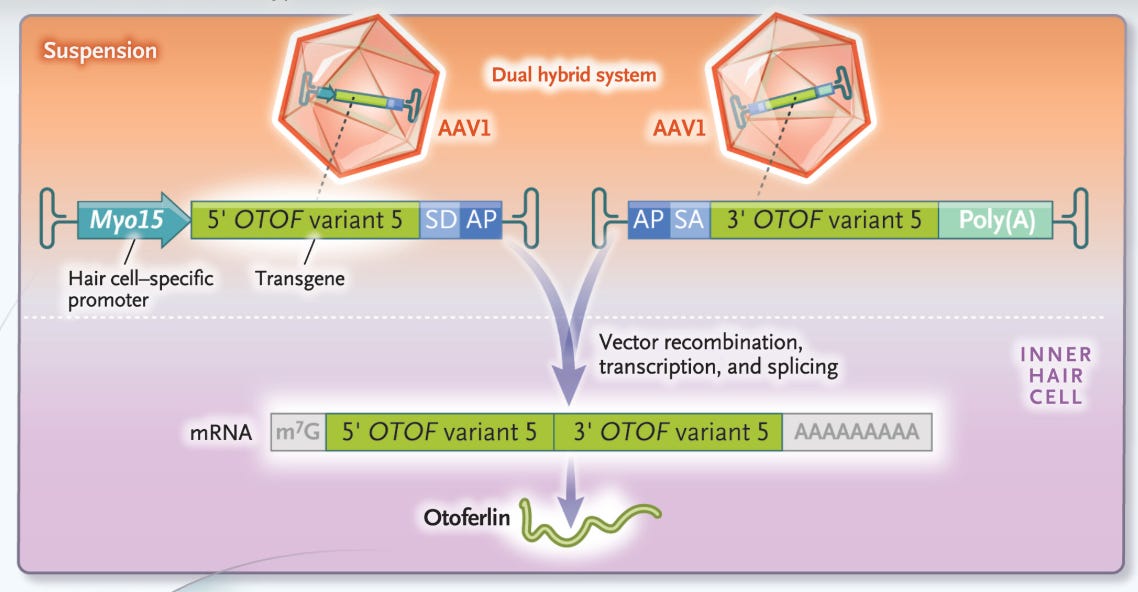
Otarmeni is a dual Adeno-associated virus 1 (AAV1) therapy with each AAV carrying half the OTOF gene. The two halves are spliced together to create a functional Otoferlin protein, which patients with the condition are missing. A cool feature is the promoter used to drive production. It is a proprietary promoter that only expresses in hair cells, meaning you will have minimal to no off-target expression of the gene.
A few more regulatory details that I found interesting. We know that Otarmeni was given priority approval because it was one of the first therapies awarded a Commissioner’s National Priority Voucher (CNPV) meaning it aligns with national priorities. They are simultaneously eligible for another voucher, a Rare Pediatric Disease Priority Review Voucher (PRV). This lets Regeneron ask for priority review on any future drug application OR they can sell it! And honestly they might be able to sell it for more than what they’ll spend on several years of Otarmeni.
2. From the Bench
The Tea: Element Biosciences recently unveiled a new technique for sequencing genomes (VITARI) and claims it will cost only $100 instead of the industry standard $200.
So what is the difference? At a very high level, most genome sequencing techniques build out copies of the template and, one-at-a-time, incorporate a base and read out the associated fluorescent signal (different colors for A, C, G, T). And for accuracy, each fragment of DNA is read many times, requiring many bases that emit fluorescence. This is expensive! Element Biosciences introduced VITARI which is based on avidity base chemistry (ABC). Instead of a 1:1 ratio of expensive fluorescent nucleotide to base sequenced, an avidite binds to multiple copies of the same next base at once, reducing cost.
A few more sips: I needed to give myself a mini crash-course on sequencing techniques and I wanted to share a comparison that helped me.
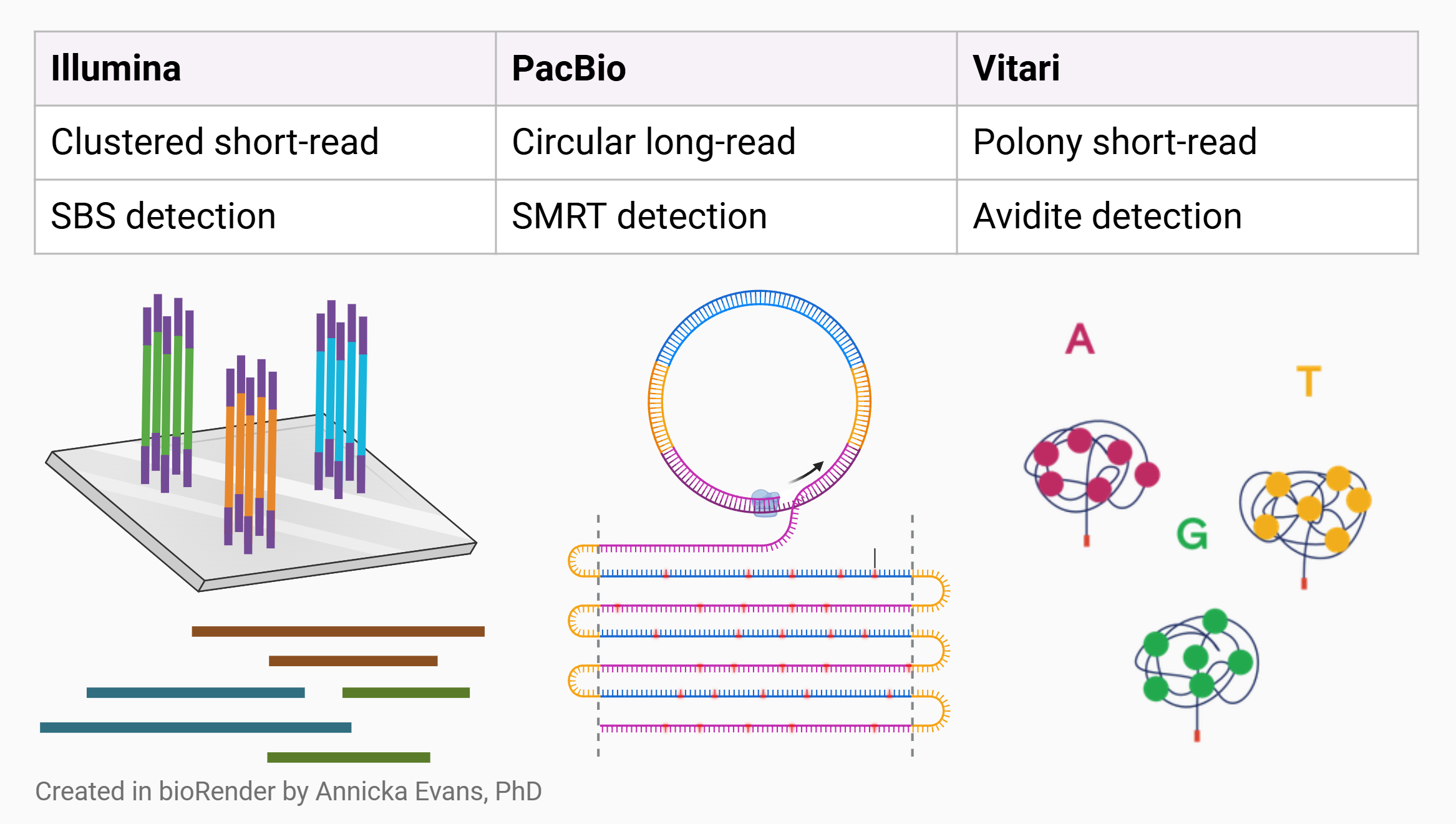
Illumina sequencing is a well-known short-read system. Your genome is fragmented into very small pieces, they are amplified to create clusters of themselves, and each is read by sequencing by synthesis (SBS), meaning the polymerase is forced to stop after each base is added so the fluorescent signal can be captured. The many results per fragment are pieced together to give you a whole genome read.
PacBio sequencing is a well-known long-read system. Your genome is fragmented into very large pieces, circularized, and a polymerase runs the circle over and over, continuously adding bases that give off fluorescent signal. This is known as Single Molecule Real-Time (SMRT). The repetitive long reads are compared to one another to resolve any conflicting areas.
Element Bio uses polony technology combined with avidite chemistry. Your genome is fragmented into small pieces (like Illumina) but circularized (like PacBio). Each circularized small fragment is amplified repeatedly to create many connected copies (rolling circle amplification) but instead of single base incorporation snapshots, avidites come in and bind to several repeats of the target base in the polony, creating stronger signal each read.
Message me if you have a recent science development you’d like to see featured!
3. Bio[Tech]
The tea: The Utah Medical Licensing board is pushing back on AI renewing prescriptions without a doctor. A few weeks back we discussed how Doctronic is the first closed-loop AI system being used to renew prescriptions for patients, and it’s being tested exclusively in Utah.

But in a letter published Friday, the Medical Board noted that it was not given prior notice about the pilot and is asking for it to stop. The Utah Office of AI Policy already responded saying they did consult specialists (just not them), Phase 1 renewal decisions are entirely reviewed by human physicians, and that they are welcome to review the pilot data as it comes out. This is our reality! AI will become a part of many parts of our future, but the question is how we implement and validate.
A few more sips: The board is arguing that the chatbot is acting as someone “practicing medicine” and that the board is specifically designed to have oversight of that.
“There is a reason prescription refills require physician authorization.” - Utah Medical Licensing Board
Dr. Daniel Aaron, a law professor at the University of Utah recently wrote a JAMA opinion article on this topic.
4. The Rulebook
The Tea: CMS and FDA jointly announced the RAPID coverage pathway earlier this month - a means to expedite Medicare coverage of newly FDA approved Breakthrough Devices. The problem? Many devices are approved but then reimbursement decisions aren’t made for months to years, delaying patient use. Regulatory Alignment for Predictable and Immediate Device (RAPID) coverage, requires that CMS now be a part of early discussions that happen between the device companies and the FDA. That way they are informed, earlier.
Important distinction: this isn’t for all devices, but breakthrough devices. These are devices that will improve treatment or diagnosis of a life-threatening or debilitating condition and either no alternatives exists, they offer major advantages over existing options, or availability is crucial for patients.

5. The Human Side
The Tea: I recently stumbled upon a Substack article by Life Science India that, I thought, gave helpful career development advice for biotech scientists. They articulate that having the ability to bridge technical science with business decisions is a way to really differentiate yourself amongst talent. The 6 differentiating skills they highlight are:
Be able to scan a paper and summarize it in 20 minutes or less.
Understand basic business and financial basics.
Know the basic pathways for regulatory approval.
Practice your communication skills to a variety of audiences.
Be literate in trial design and statistics.
Place yourself in cross-functional positions so you understand values of each.

A few more sips: If this sounds interesting to you, the article goes on to highlight 4 tracks that help with this bridging. I’m in the middle of doing something like this right now with CMC regulatory! My company gives full-time employees the opportunity to do internal internships that allows you to grow into a new area while also supporting a project or need. I’ve been on a steep learning curve but am enjoying it and can already tell it is making me better equipped in the biotech space.
Biotech Term of the Week
The next 4 weeks we’ll be covering the FDA Expedited Programs that move a drug to approval quicker. We’ll build a table as we go.
Fast Track Designation
